🍽️ Restaurant Visit: Rapaz
A trip to a hidden lunch gem bringing north Spain’s cuisine to Mercado Los Monstenses.

Explore more coverage of Madrid art and culture here. Subscribe for more trend dispatches, about life online and off ⬇️

I met Rita Juárez through Ben Dietz, who tagged her in a post on LinkedIn where I shared that Bobby Aaron Solomon and I were going to Madrid. She sent a note and we chatted for some time, bouncing back and forth before setting a time to meet and, given that we both had a Wednesday evening free, we connected the dots and agreed to meet for a cocktail at Marrufo before grabbing dinner at Kitchen 154. Easy, great, done: simple enough. Then a friend of ours who owns a restaurant in Barcelona told us that, if we go anywhere in Madrid to eat, we had to go to Kitchen 154 and report back as they’re obsessed with Kitchen’s chef. Then another friend said the same thing, which was then echoed by Sina Sohrab: you have to go to Kitchen. What was funny was that we hadn’t heard about the place until Rita mentioned it — and she mentioned it because she’s involved with the restaurant. Clearly this is someone who is someone in the city.
That Wednesday, we had a delightful evening as various characters in the Conde Duque neighborhood popped in and out, saying hello to Rita, offering recommendations, and generally vouching that, yes, this is a great person. Rita — with a tight bun and stylish glasses, donning a combination of streetwear with chic athletics, something between full gorp and SSENSE — shared that she splits her time between New York and Madrid, working in both cities but finding herself called more to Spain, as she’s from the north, from a small town called Léon. You’ve probably never heard of it, she told us. It’s very small. Funny enough, I had heard of it as a Spanish teacher I had was from there and had said the same thing: it’s a very tiny, very cute town that we would never visit because there were so many other places that would undoubtedly call to us. Rita agreed but, as my Spanish teacher also said, it’s absolutely precioso, a gem within the very varied and wide country. That’s why she decided to open her own little restaurant, to make food from the region with a friend. It was her passion project, what she spent much of her time dedicated to as it had launched mid-fall — and had tables booked through mid-May.

Called Rapaz, as adults called mischievous kids up north , the restaurant is at the bottom of the Mercado Los Monstenses, a diverse gathering of stalls that reflect largely South American cuisines, cultures, and food, most notably Ecuador and Peru. These stalls are marked by typical anti-designer gestures that you’re as likely to find in Texas as you are in New Jersey, as you are in London as you are in Paris: bright colors and digital collages of chefs holding over-large plates, flags to represent the food next to claims of how great said food is. Even if you haven’t been to this market, you know the experience well: you’ve been to this place. Rapaz, in contrast, feels like more like it should be in Chelsea Market or Grand Central Market — or it’s in a realm all its own that such "nice” venues wouldn’t quite get: with its modified gothic font and gingham prints, red lacquered kitchen and industrial fixtures, it’s both now and then, new and old, north and south. A home kitchen in the city, which very much plays into new ideas that cuisine (or restaurants) are too fussy for their own good. Rapaz captures that spirit, which is to say: it’s right on time.
With two seatings for lunch two days a week, she is one of three staff members that do everything: wait tables, cook food, run plates, wash dishes — and anything else that goes into running a restaurant. We were squeezed into the second seating on the second day after a cancellation. With a bottle of cava, we went into a six course lunch (which sounds like a lot but isn’t a lot but is a lot). The lunch started with an overview of the menu, where we mostly understood what was happening (to which Rita clarified in English, afterwards, to fill in any blanks).
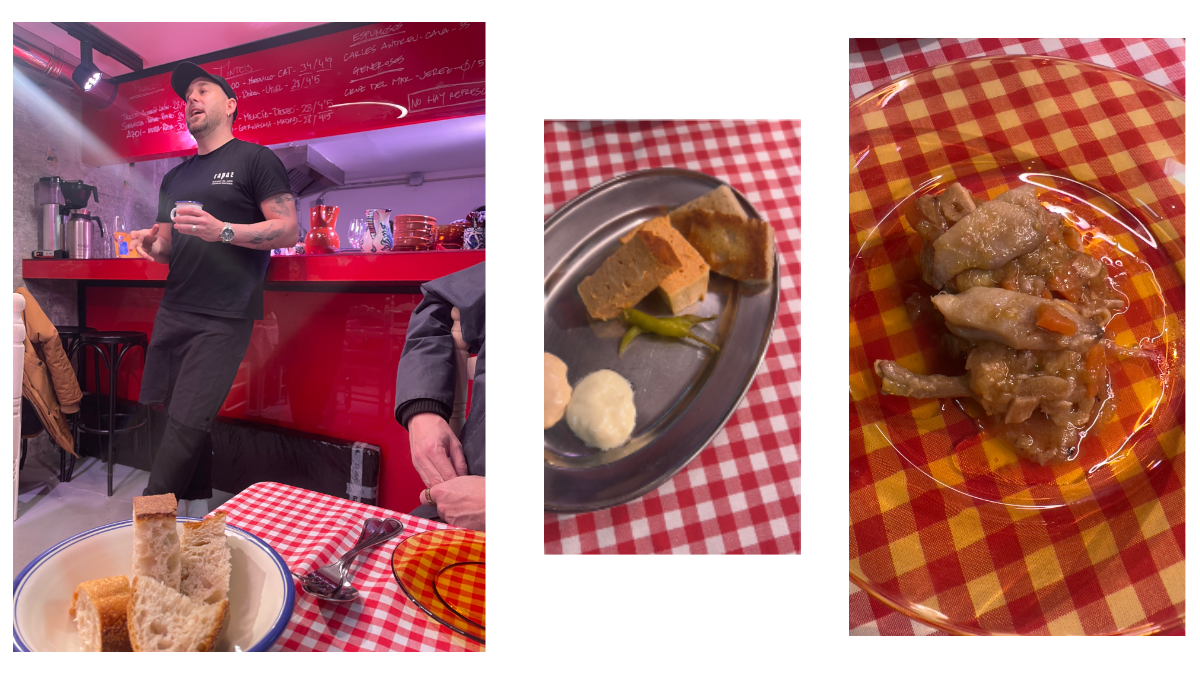
First, a pastel de kabrarroka, which is a riff on a traditional fish cake which Rapaz is doing in conversation with a version Arzak had been doing in San Sebastian. Made with a scorpionfish, the dish is something between a quiche and a pudding but also neither of those things, landing somewhere between a souffle via a Spanish tortilla. Light and fluffy with the concentrated flavor of this fish (which, to my surface-level palate reminded of tuna), you used the cake to dip in and out of aiolis and grilled bread, riffing however worked for you. This was followed by another this-but-that dish: escabeche de pollo y verduras, which is like a sour soup where a meat, sauce, and pickled vegetables come together. For Rapaz, this meant lollipop chicken wings and chicken comb with pickled carrots and onion, which came together to offer the feeling that you were eating a pickled chicken soup, as if soup stock was standing still, caught in a brief moment where liquid turned solid. It was delightful, even if it was wholly unique to only us in the restaurant.
Then, a series of stews-but-not. First: callos a la asturiana, a tripe stew that is usually tomato based in Madrid but is more paprika based in the north, where Rita and the team are from, which was served with sliced potatoes that were cooked in aged veal oil, all of which came together to form a fatty, paprika meat dish where you could practically taste the collagen (I meant that in the best way possible.) as you could clearly tell this wasn’t something you should eat all the time but it was a special once-in-a-lifetime treat — or until one goes back to Rapaz. Next: verdinas con marisco, which are a type of green bean typical of the north, in Galicia and Asturias, that was stewed with clam, monkfish, and shrimp, which looked like a cozy, warm-day stew but was more like a light, fresh soup where the beans were fresh enough to retain their composure within a liquid state and where the seafood didn’t overpower the dish, making it a tour of both local-but-not legume and seafood faves. Both were delights, both special (the latter of which was Rita’s favorite, which she said is perfect for any time of year, something I’d attribute to the lightness of the dish).
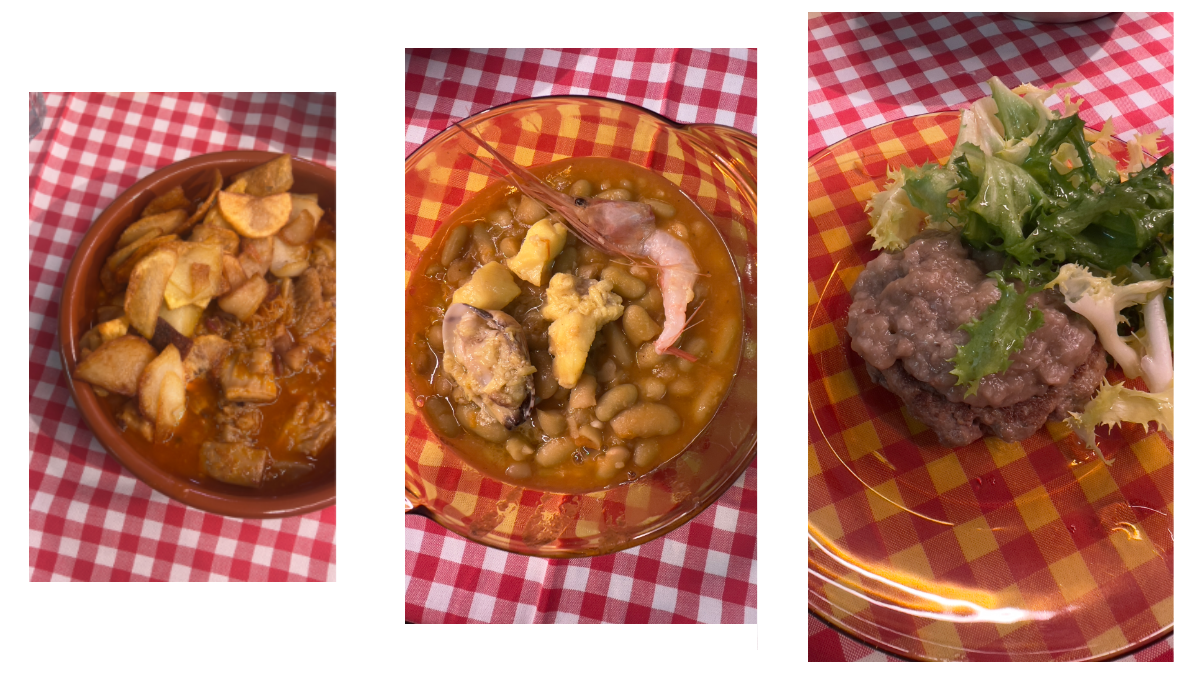
Last (as far as entrees), was a surprising dish in that, to the American eye, appears like a deconstructed burger. Called filetes rusos, this is a lightly seared beef fillet that is made with a sauce that can only be described as an onion gravy which may be difficult to comprehend — but literally imagine a traditional (American or British) turkey gravy. Instead of turkey, substitute onion that has been reduced to the point that it threatens to take on another state, akin to what happens in a tagine when reduced down to its most elemental: that’s what we’re talking about, which was a rare, curious experience that made for quite the complimentary culinary treat. Along with a sharp friseé salad, it was easy to understand why this was the sort of dish that a mother would eat every night at the end of a long day (which, again, is what Rita told us was something her own mother did).

To end the meal, we had leche frita — fried milk, almost literally, where milk with cornmeal and some dried egg created a custardy, “solid” treat — along with lightly coffee flavored wafers. As we finished the meal with these sweet items, we chatted with Rita as the people filed out. We learned that the space was previously extra seating for a nearby Peruvian stand and, at one point, it was a concept for the ACID team. While the concept enters it’s half-year mark, as Rita and the team consider the future, it was very clear that they had solidified themselves as a home-away-from-home for locals while being a culinary adventure for the uninitiated like ourselves. It’s also a testament to just doing something instead of talking about it: Rita and her partners at Rapaz ended up with a restaurant after making food from their home, from their part of Spain, for friends to the point that people started asking and asking for more. Then, they took a leap to trying out the concept with a space — and it stuck.
Now they’re figuring out how to balance their work-lives (Rita, for example, is a creative director.) with trying to keep their restaurant world going. As all of us with passion projects can attest, it’s hard work to balance both. It’s not impossible, as the dream offers the steam to continue, but it is something that inspires you to rearrange your life, to make things work, to keep doing the thing you love because you know it brings other joy too. And who knows? Maybe the concept will travel which, given Rita’s here-and-there-ness, could actually happen.
Follow Rapaz on Instagram and find them at Mercado de los Mostenses, Puesto 50-51.
stoked that this worked out so well - Rita is awesome 😎