TR.BIZ: 10.29.2026
From digging deep on wedding trends to LA restaurants in NYC, this is your late-mid-week check-in 💫

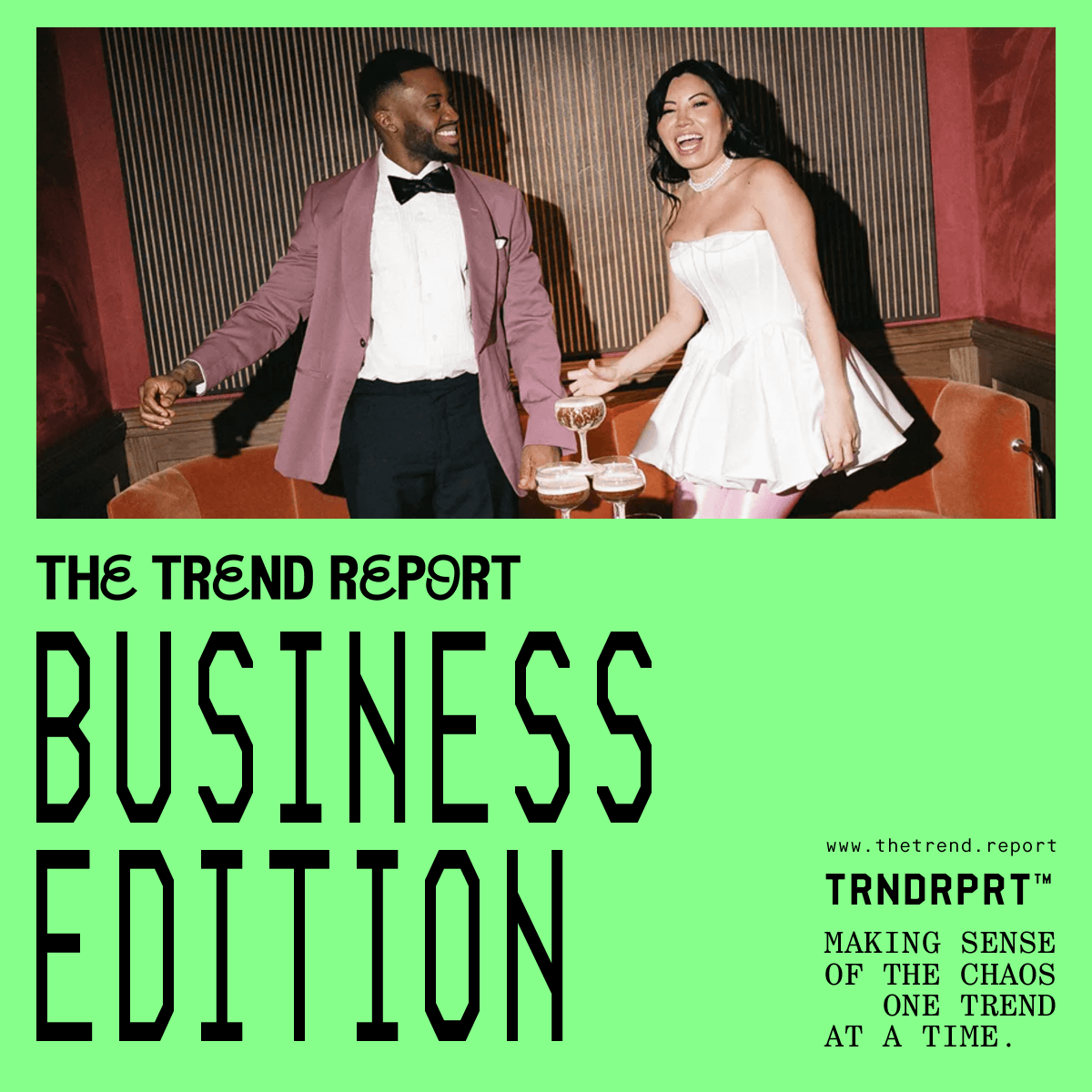
Welcome to The Trend Report: Business Edition™, a midweek look at top stories, trends, and more of what’s happening online and off by Kyle of The Trend Report™. Today, we’re doing a deep dive on 2027 wedding trends, why the word “freak” is having a moment, why AI might be charging you more depending on the language you speak, and why trans actors are jobless.
👁️🗨️ Listen In: Analogue culture as proof of human excellence
“It’s wish fulfilment, it’s manifesting,” I explained of Gen Z and larger cultural pushes toward analogue items, old tech, and things like microcinemas, during the Q3 walkthrough. “It reminds you of what, for lack of better words, human excellence has been and can be…Last year at this time we were talking about friction and the need for friction. But I think that conversation and exactly this analogue ‘poptimism’ is going to evolve into purpose and feeling like you have a purpose and that things have a purpose. Because, in the time of AI agents fucking doing everything and solving every math and science problem and doing all the art, what is my purpose? What am I doing here? What do I belong to as far as community? I think those questions become really important for us, but they also become really important for the objects that we have. That speaks to analog desire because I don’t want a fucking refrigerator that has a screen on it that connects to my phone.” This all came from reflecting on an essay I wrote about the Gen Z protests and how the discontent with systems will ripple to the consumer space, which very much feels like the subtext of so-called “analogue” pushes. It’s interesting! Listen in on the full walkthrough of the Q3 Report™ here, where this quote came from, then pick up the report here. If you’re a paid subscriber, send me a note and I’ll send you your free copy!
🔎 Digging Deep: Wedding trends signal economic malaise
Tuesday morning I jetted down to Midtown South in Manhattan for an intimate presentation-panel from The Knot to go over their 2027 trends forecast that they believe will define weddings in the near future. It was a fascinating hour, hearing from experts like Danielle Elder of Classic Events, Carly Katz-Hackman of Pinch Food Design, and Micaela Erickson of the venue Vesper, all exploring these in-the-make wedding ideas with the brand’s editorial director, Esther Lee. They mapped 20 trends to watch, ranging from predictions like French Mediterranean inspired spritz bars becoming a spot for guest sips, the rise in the color silver as an expression of vintage opulence, and the spreading of a wedding (and dresses) from one single event to a multi-day, multi-functioned affair. Dua Lipa and her understated but extravagant wedding came up again and again as she appears to be the most covetable wedding as opposed to Taylor Swift’s indulgence: Dua offered nuptials that were intimate, unexpected, and rule breaking, feeling more like quiet inventive elegance versus the traditional but loud. (Interestingly enough, the other names that came up as far as wedding inspiration were influencer Paige Lorenze’s American princess moment and restauranteur Mario Carbone’s traditionally untraditional NYC affair.)
What I kept hearing in trends like taking inspiration from fine art, the use of unique-to-you props, and the interior design-ification of weddings is a desire to feel special not just on your special day but within a cultural landscape that is impossible to break through and that works proactively to flatten you, to make you another number within a population. This isn’t surprising, as these demeaning economic conditions makes us claw to be individual as to be “marketable,” which sees weddings take on this quality in quite a noisy way (Making your own you-had-to-be-there photo backdrop versus a photo booth!) while people attempt to be as demure and discerning as possible (The rise of “hush-hush honeymoons” and non-traditional venues.): that’s the tension of weddings now. You must be seen and heard, in a way that draws eyes to you and illustrates your uniqueness all while resisting your being an item for consumption. You want to be inspiring, but you don’t want to be something swallowed up by the media machine. You want to be viewed but not an object of surveillance’s affection.
This brings me to the larger feeling of the trends that may be grim but absolutely logical and of-the-times: the modern wedding is less an act of love and more a networking event. This is obvious, that people meet and connect and fuck and collaborate at weddings, but also that weddings are a space to flex the talents and “taste” of a couple as if something to add to one’s resumé. Gone are the bridezillas and in are aspiring power couples larping as creative directors: we see this in custom crests, illustrations, and monograms offer the wedding a brand identity; we see this with a move toward pop-up stations like fragrance and flower bars, zones within a wedding that are easy to sponsor; we see this with menus that merge the cultures of the spouses, showing how two people can collaborate and merge together, that this is a merger that could be a restaurant concept; we see this with editorial photo shoots serving as both documentary ephemera and unstaged moments of you working the room within your creation, proof of your “managing” and “leading,” too busy to stop for staged moments. You want your day in the sun as much as you want to show your co-workers and LinkedIn that you thought of everything. You do this within a time of being unable to ascend the corporate ladder, showing how you can and will be the CEO of your own wedding and ostensibly a company too. This is a fascinating shift from a religious sacrament to a brand building flex, two businesses merging with an audience. Love is love, but love doesn’t make you money — but a good wedding, full of marketable ideas? That is the best gift you can give you and your future, it seems.
We all want to be famous, we all want to feel special, and the wedding is a rare moment where that still happens. As Katz-Hackman said, “it’s your responsibility to make [guests] feel subconsciously safe…allow them to kick off their shoes, let loose, and have fun and be their most id-driven self.” The responsibility to caregive guests has always been a part of weddings yet that feeling now furthers the feeling that the bride and groom are innkeepers, restauranteurs, entrepreneurs, entertainers in addition to being lovebirds: those getting married now are multi-hyphenates who hope to take the credit, eclipsing those hired to work the wedding (or those funding it). This specific economic context underlines these feeling. That also means you as the host-turned-CEO has to be the biggest person in the room, even if that is obvious. Consider how weddings now include the courthouse and the ceremony and multiple dresses (Even haircuts!) to maintain all eyes on you within the attention economy that leaves us all powerless. “When people are in their bridal era, they want their bridal council,” Lee said, noting how couples are savoring every moment and everyone involved. The issue? The iconic clashes you hear about between brides and grooms and families with on-site staff, from caterers to planners to photographers and site managers — and everyone in between. “You’re hiring them for their taste, because you trust them,” Katz-Hackman said. “If you make every conversation a debate or argument, you’re only setting yourself up to not enjoy the process and to fight upstream. Trust the people you hired. You hired them for a reason.” Letting people be experts helps you, as the bride and groom, which illustrates the type of “boss” one is. Will you be a micro-manager? Are you one to give phoned in performance reviews? Do you thank your team and give gifts? Imagine a reverse Yelp where staff rates clients. How interesting that would be for our wedded CEOs. “What happens when you distrust [vendors] through the process is they’re not allowed to do their best work,” Elder said. “There should be a mutual respect and trust…Let us do our jobs.”
Funny how everything became work. Even love! No wonder people are overthinking and micro-managing this moment just as corporations are wont to do now: love is now more a business at a time when finding a partner — like finding a job — is an increasingly rare proposition.
You can read the full 2027 wedding report here. Here are a few quick thoughts about other trends that came to mind from their report —
