TR.BIZ: 10.20.2026
From the latest Gen Z protests to Lady Gaga’s Halloween agenda, this is your early-mid-week check-in ✨

Welcome to The Trend Report: Business Edition™, a midweek look at top stories, trends, and more of what’s happening online and off by Kyle of The Trend Report™. Today, we’re talking Gen Z protests in the 2010s versus the 2020s, a GOP news bias drama, Hollywood moving to NYC, and proof of our unoptimization desires.
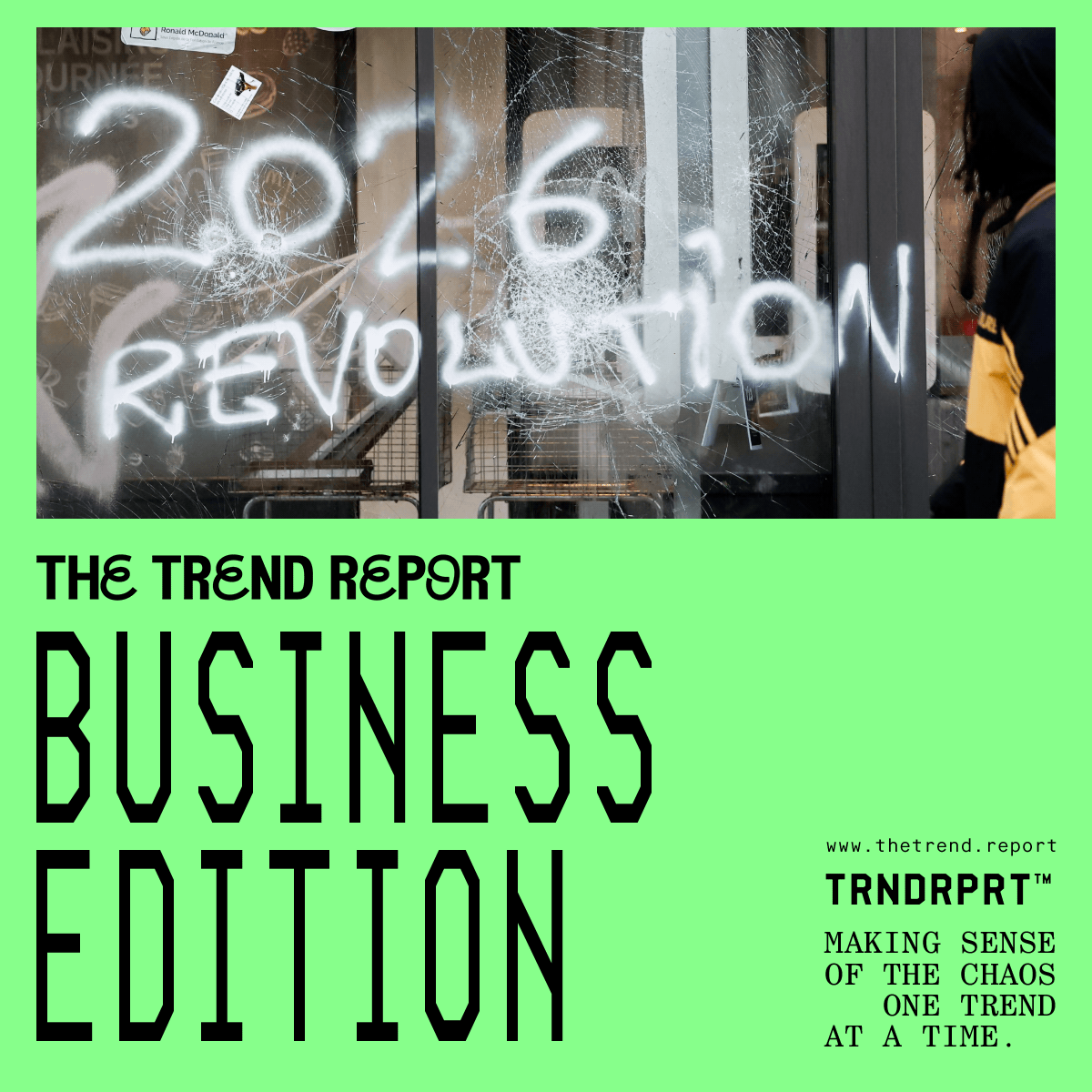
🏛️ Politicultural: How are 2020 Gen Z protests different from 2010 Gen Z protests?
If 2025 was about Gen Z protests in Asia and Africa, 2026 has been about Gen Z protests in Europe. By this logic, we’re barrelling toward Gen Z protests in America in 2027 as an east-to-west creep of unrest takes over, all of which is happening in bigger (Indonesia) and bigger (India) countries. Recent protests in France, Spain, Portugal, and beyond indicate that these movements — which are marked by the media focusing in on how loud and “violent” they are — are in response to a lack of opportunity in society, which starts with schools (as in France) and ends with housing (as in Spain). These are issues of survival, which express a dysfunctional status quo that has not shifted in decades and is felt on a global level, by left and right governments, all of which has remained “fixed” as a bygone — and often leftwing — agendas seek to maintain a 2010s or 2000s or further back past in a quickly changing present where weeks and months do the work of years as no one in power does anything about it. This — the protests, the inaction — are all huge political gifts to the right too. This is a defining storyline of the latter 2020s that I fear people are overlooking because of the French-people-being-French-people of it all or the “Americans don’t have the balls!” conversation of it all: this is more an expression of generational and class-based warfare, the young and the poor demanding change by old and rich people who don’t think they have it “that bad.” (Mind you: when Black Americans stand up similarly, they aren’t given this respect or these revolutionary attributes — but that’s a whole other thing.) (Also: let’s not forget or invalidate Minnesotans earlier this year or Los Angeles last June. Such lines of thinking invalidate American action and minimizes the need for such action, which are all gifts to rightwing ideology.) What I’ve been stuck on, and is a key item we explore in the Q3 Trend Report™, is how these protests in the latter 2020s match up and diverge from the 2010s Greta Thunberg-era protests. Those quieter protests were led by those who are now in their early-to-mid twenties, as Greta is only 23 today: we’re witnessing a bookend to a conversation they started a decade ago, that society laughed and patted their heads to, only to shoo them away, thinking they would stay away as all grievances were ignored. How was that 2010s moment different from this 2020s moment? How did the movement grow up? How does it reflect “times like these” given the many happenings between then and now (AI, Covid, climate collapse)? There are many differences to consider, which we discuss in a data analysis where researcher (and my sister) — Mickey — helped pull stories about that moment so we could compare it to this moment. Here are key findings that I think help understand the mindset of this moment —
Youth protests in the 2010s and the 2020s occupy very different vibes.
The 2010s was viewed as hopeful and participatory, with protests that sought to push the world forward with change being the desired outcome.
The 2020s are about fighting against repression — and seeking consequences for suppression while pushing through the various guardrails placed around preventing young people from challenging the system.
Unlike youth movements in the 2010s, youth movements in the 2020s have clear goals and clear targets.
Whereas the last decade may have fought to “save the planet” and for “racial justice,” the 2020s targets specific people and calls them out. Naming and blaming a villain offers tangible evils versus “the system.”
This is why coverage of 2020s movements align with conversations about resignations and leaders being forced out, as this framing jumped from 7% to 26%.
We dive into more findings too, but I wanted to share as 1.) I’ve not seen these moments compared and 2.) I’m trying to sell these gd Reports™ so I’m singing and dancing and proving their and my worth to you. Anyway, It’s interesting to see and understand to recognize that a generation, who was quietly asking for the planet to be saved and to end gun violence, is now fed up and jaded — and they’ve had enough of having their future(s) robbed from them. This isn’t just an of-this-moment discontentedness but something that they, in their near three decades of life, have learned so well: the system has long been broken and no one cares to fix it. Now is the time to solve these systems — or they will be broken. Dive into this in the latest Q3 Report™ and, if you’re a paid subscriber, DM me and I’ll send a copy your way.
🎪 Eventful: Review Q3 with me
A reminder that I’ll be doing a live speedrun of the Q3 Report™ this Friday, 23 October, at noon EST / 9A PST / 6P CEST. You can ask questions, share thoughts, and get a “preview” of the full 70+ page report. Plus? You get to hang out with me 😘 See yous there!
🤩 Hollyweird Insider: Will Lady Gaga ever become the queen of Halloween?
